October 2, 2025
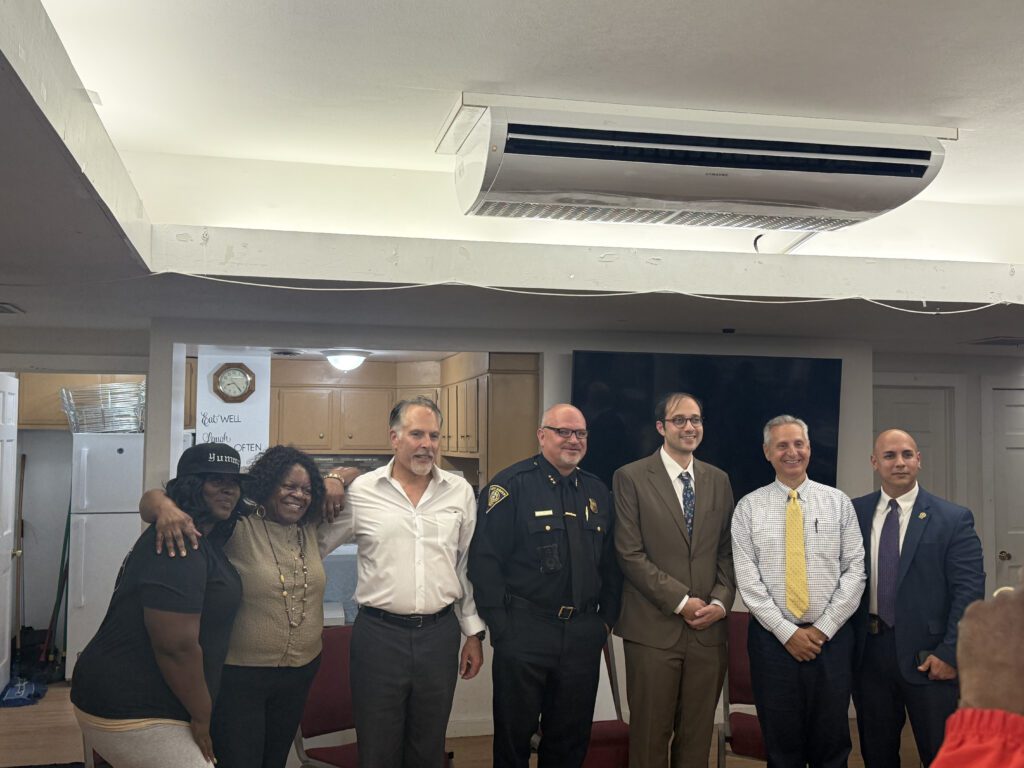
Last week, Barbara Fair, criminal justice activist and executive director of Stop Solitary CT, hosted a panel featuring Civil Rights Attorney Alex Taubes, Attorney Chris Demarco, a representative from CT Pre-Trial Services, and Karl Jacobson, the Police Chief of New Haven. All involved in the criminal justice system and bail process in some form, these influential New Haveners came together to attempt to answer the question: How can we improve decision-making surrounding bail? Among the meeting’s attendees were several formerly incarcerated community members, loved ones of incarcerated people, members of Stop Solitary CT, journalists, and newcomers simply interested in the topic of bail.
Fair opened up the conversation with a striking factoid: over 40% of prisoners are locked up simply because they can’t afford to pay bail. Tensions filled the room as each of the panelists attempted to make sense of this fact, given their varying perspectives as stakeholders in the bail process. Police Chief Jacobson reflected on the persistence of sentencing disparities he’s witnessed firsthand within New Haven’s justice system despite the general downward trend of arrests and crime in the city. “I’ve seen people get 25 to life for an ‘8-ball’ just because they have 3 prior felonies, while someone else with no priors and several kilos might only get 5 years,” he remarked. Despite the city-wide reduction in crime and implementation of carceral reforms, the system still seems to be perpetuating this sort of racialized cyclical entrapment, one that might spare a first-time offender but has no mercy for people with a history of confrontations with the state. So how does bail play into this?
Also on the panel, a representative of the New Haven Bail Commissioner’s Office brought the role of Pre-Trial Services into the conversation, explaining that the role of PTS is to review bonds set by police and make independent recommendations for bail to judges during arraignment. Additionally, the branch is responsible for bond review services (in which PTS offers support & help contacting loved ones to people with bonds < $200k) and working with defense attorneys to set up other supportive services (i.e., mental health counseling) to people being held. Attorney Taubes jumped in to emphasize how integral Pre-Trial Services will be to achieving any sort of tangible bail reform. When you have virtually no money, no family, and no resources, he argued, it’s nearly impossible to fight your case while incarcerated. Looking at President Trump’s recent striking down of bail for immigrants facing deportation, for example, we can clearly see how bail is being used as a weapon to effectively put people at a disadvantage in political bargaining by forcing them to fight for their freedom while they’re actively being stripped of it.
Another pertinent issue brought up by Fair was the so-called “slippery slope” of preventative detention, or the setting of a high bond due to predictions about someone’s future criminality. Police Chief Jacobson justified the utilization of this practice, arguing that the police department has knowledge of people’s “next moves” and uses a combination of public safety risk and other bond elements to determine the amount. But what about the thousands of offenders that pose essentially no risk to society by these metrics, yet still face bonds in the hundreds of thousands of dollars? What about the non-violent offenders who are promised a “speedy trial” but sit in Connecticut jail for as long as 5 years waiting for their cases to be brought? The panelists toyed with plausible solutions to these issues—could the solution be to let everyone with a bond under a certain dollar amount out? Attorney Taubes contributed to this conversation by challenging the logic of sentencing altogether. The notion that “more years = more justice” is a fallacy, just as the idea that police can predict crimes before they happen is, alike. If the carceral system is meant to rehabilitate, why is it that even those offenders who become truly “rehabilitated” while incarcerated may never see freedom? This point raised important questions about the true purpose of the prison, what actors benefit most from bail inflation, and the credibility of metrics used by police & the state to calculate things like bond, sentencing, and risk.
By this point in the meeting, it seemed like the central question had yet to be answered. So what does bail reform really look like? Barbara Fair jumped back in, pushing the panelists to consider the Supreme Court as an avenue for fighting bond inflation. Attorney Taubes noted that the Supreme Court had a significant impact on bail politics when it ruled that prisoners can file sentence modifications while incarcerated. But outside of this, most reforms have been left to the states, yielding varying degrees of change. In Connecticut, there have been only marginal changes to bail, while other states have abolished the money aspect of bail completely, leaving it up to judges to decide whether someone is held or released before trial. And while this might seem like a great solution, as Taubes pointed out, even this poses issues in cases where there is a shortage of judges, and it might be faster to have the option to pay, for example. So, how can we balance the simultaneous needs to protect the constitutional right to pay bail and to lessen the disparities erected by existing bail systems? The representative from the Bail Commissioner’s Office suggested that there is no “best” bail system, and that the most effective reform model might look like a bridging of the most successful methods from each of the states’ bail systems.
Perhaps this offers us a place to start, but even in an idealized world where we’re able to solve this “bond problem,” the conversation becomes convoluted when we consider the extent to which the carceral state has become more a web of relationships than a set of physical institutions. For example, if, when people post bail, they are still subject to excessive surveillance and mobility restrictions, are they truly “free” on bond? Or are they being punished before a verdict is reached, thus violating the presumption of innocence? What about the fact that judges are prohibited from considering house arrest as counting toward a sentence, thus ensuring that people serve more time down the line if they opt out of being held pre-trial? Or, what about situations like that of the community member who stood up to share that even after making his bond, the bond collector raised a second one, and upon him making that one, punished him with GPS monitoring & 24-hour house arrest? These scenarios make clear that there is much more to be said within this discussion, and that considering reform in one small part of the criminal justice system, such as bail, often requires us to consider the role and function of the carceral state as a whole.
Barbara Fair & Stop Solitary CT are seeking to hold space for these sorts of conversations that spur collective action toward positive change within the criminal justice system. “We’re not talking about a tweak here or a tweak there, but something fundamental,” she told the group. Attorney Alex Taubes has demonstrated his commitment to this cause through his diligent efforts in the field of civil rights law, and this impactful conversation with divergent perspectives regarding bail reform was yet another testament to the importance of this work.
Written by Erin Kearney, Yale College ’27