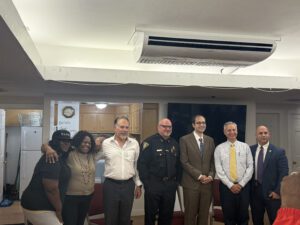
My name is Frank Torres, a rising senior at Harvard College. At the start of my internship, attorney Alex Taubes gave me a copy of Vision: A memoir of Blindness and Justice by Judge David S. Tatel. Alex worked for Judge Tatel in his early legal career, helping him read documents. Alex believes that an internship is also about mentoring. It is essential to pass on what he learned from his prior mentor. Reading Vision gave me insight into the purpose of lawyers and the importance of resilience in the face of injustice.
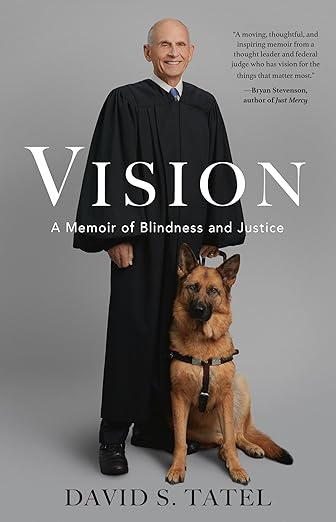
The greatest thing you can do is make life fair for others and fight against injustice. Judge Tatel has accomplished being an anchor for a variety of different disadvantaged groups. He has done this while progressively losing his eyesight due to Retinitis Pigmentosa, which is a genetic disease that degenerates photoreceptors. Tatel completely lost his sight in his 30s, but his tenacity and care for people kept him focused on the rights of others. Using various forms of technology, such as a braille computer, audio books, and finally, his service dog Vixen.
In his memoir Vision: A Memoir of Blindness and Justice, Judge Tatel reflects on the challenges he underwent as a lawyer to being on the federal bench on the D.C Circuit. His life story is not about his blindness; it is about pushing through obstacles in your life to pursue justice. He does a great job of explaining the court system and laws to the reader; you do not need to have a background in law to read his book.
Resilience shapes a lawyer’s path. In his early career, he worked at a law firm involved with traditional litigation. While working there, he never informed anybody of his diminishing eyesight. Choosing to keep his struggles to himself, he continued to work while losing his central vision. By intuitively altering how he accomplished tasks, such as moving his head side to side as he walked. He mentions lightly brushing arms with the person he was walking with to get around as his eyesight continued to deteriorate. He notes that he did his best to ensure that his blindness did not play a part in his decision-making when judging.
He worked on the case Tometz v. Board of Education of Waukegan City School District, which involved changing school boundaries in Illinois to promote racial integration. This experience taught him firsthand that it is a lawyer’s responsibility to use their skills to fight for civil rights. For Tatel, becoming a lawyer was never about prestige—it was about fulfilling the duty of the profession, as he puts it, “to use talents and skills to litigate important civil rights issues.” Ultimately, as the director of the Chicago Lawyers’ Committee, he embodied what it means to be a lawyer-statesman: helping disadvantaged communities gain access to justice in U.S. courts.
Judge Tatel’s memoir reminds us that obstacles are worth fighting through to make your community or nation more fair. Young lawyers and students can learn from his story about resilience and courage to make real changes. We should remember how Tatel deals with injustice, saying, “ A judge’s job is to apply the law to the facts of a case. There’s no room in that process for opinions or feelings.” He is a person who has persevered through adversity when he could have given up, but put others before himself.